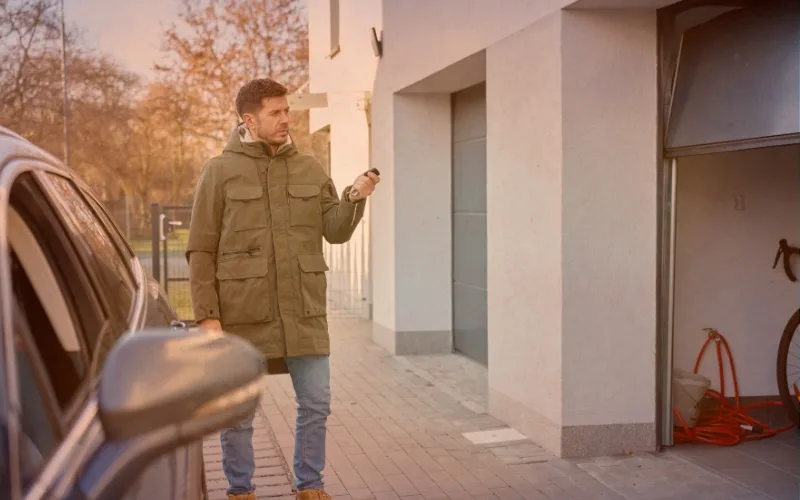
According to Boston PD crime data, the garage is the primary entry point in over 30% of residential break-ins in Greater Boston. Most of these are crimes of opportunity — a burglar testing for easy access in under 60 seconds and moving on if they find resistance. Here's exactly what they're looking for and how to eliminate each vulnerability.
Vulnerability 1 — The Emergency Release Cord
The red emergency release cord hanging inside your garage can be triggered from outside the closed door using a wire hanger or thin coat of wire slipped through the small gap at the top of the door frame — a technique that has been documented in multiple Greater Boston burglary reports over the past several years. Once the cord is pulled from outside, the door disconnects from the opener and can be manually lifted from the outside without any key or code.
The fix is simple, free, and takes 30 seconds: loop a zip tie through the release lever mechanism so the cord cannot be pulled far enough to disengage. A zip tie won't prevent legitimate emergency use — if you're actually trapped inside, enough force will break the zip tie — but it defeats the wire-hanger technique completely. Buy a 10-pack at any hardware store for $2 and do this today.
Vulnerability 2 — Old Rolling Code Openers
Garage door openers manufactured before 1993 use a fixed binary code — a single code that never changes. That code can be captured by a "code grabber," an inexpensive device that records the signal from your remote and replays it later. If your opener is 30 or more years old, this is a real and documented vulnerability, not a theoretical one.
Modern openers use rolling code technology (also called hopping code), which generates a brand new unique code with every single button press. Even if someone captures your signal with a code grabber, that code is already expired and useless by the time they try to use it. If your opener predates 1993, replacement is the only fix — and modern openers cost $150–$250 installed, which is money extremely well spent on a 30-year-old security liability.
Vulnerability 3 — The Garage-to-House Door
Even if a burglar gets into your garage, the interior door between the garage and your living space is your last line of defense. Many Boston homes — particularly triple-deckers, older colonials, and converted multi-families throughout Dorchester, South Boston, Jamaica Plain, and beyond — have hollow-core interior doors between the garage and the house, fitted with basic passage knob sets that offer minimal resistance.
A hollow-core interior door can be kicked through in seconds. Replace it with a solid-core exterior-grade door — the same type used for your front door — and fit it with a proper deadbolt. This is a one-time investment that creates a genuine barrier rather than a speed bump.
Vulnerability 4 — No Motion-Activated Lighting
Burglars strongly and consistently prefer darkness. A well-lit exterior eliminates one of their primary advantages — the ability to work unobserved. A motion-activated light positioned above the garage door activates the moment anyone approaches, which deters opportunistic burglars who rely on not being seen.
Add a second motion-activated light inside the garage, positioned to illuminate the interior when the door is opened or when anyone moves inside. This creates a situation where a burglar inside the garage is suddenly lit up from two directions with no warning — a situation they are strongly motivated to avoid. Smart LED motion lights with adjustable sensitivity cost $25–$40 at any hardware store and install in 15 minutes using the existing light socket. No electrician needed.
Vulnerability 5 — Remote Left in Your Car
A car broken into on the street outside your home — or in an airport parking lot, a shopping center, or anywhere else — with a garage door remote clipped to the visor or left in the center console gives a burglar two things simultaneously: the means to enter your home (the remote) and the address (your vehicle registration in the glove compartment, which is required to be kept in the vehicle in Massachusetts).
With those two items, they know exactly which house the remote opens and have a key to it. Switch to a keychain-sized remote you take with you when you leave the car, or use your smartphone as a remote through a smart garage door controller. Never leave a standard remote clipped to a visor in an unattended vehicle — it is equivalent to leaving a labeled spare key in the car.
The 20-Minute Security Audit
- Zip-tie the emergency release cord lever (30 seconds, cost: $0)
- Check the opener's manufacture date or model number online — replace if pre-1993
- Inspect the garage-to-house door: is it solid-core? Does it have a deadbolt? If not, upgrade.
- Install a motion-activated light above the exterior garage door and one inside the garage
- Remove the remote from your car's visor and switch to a keychain remote or smartphone app